Stop Losing Money Day Trading

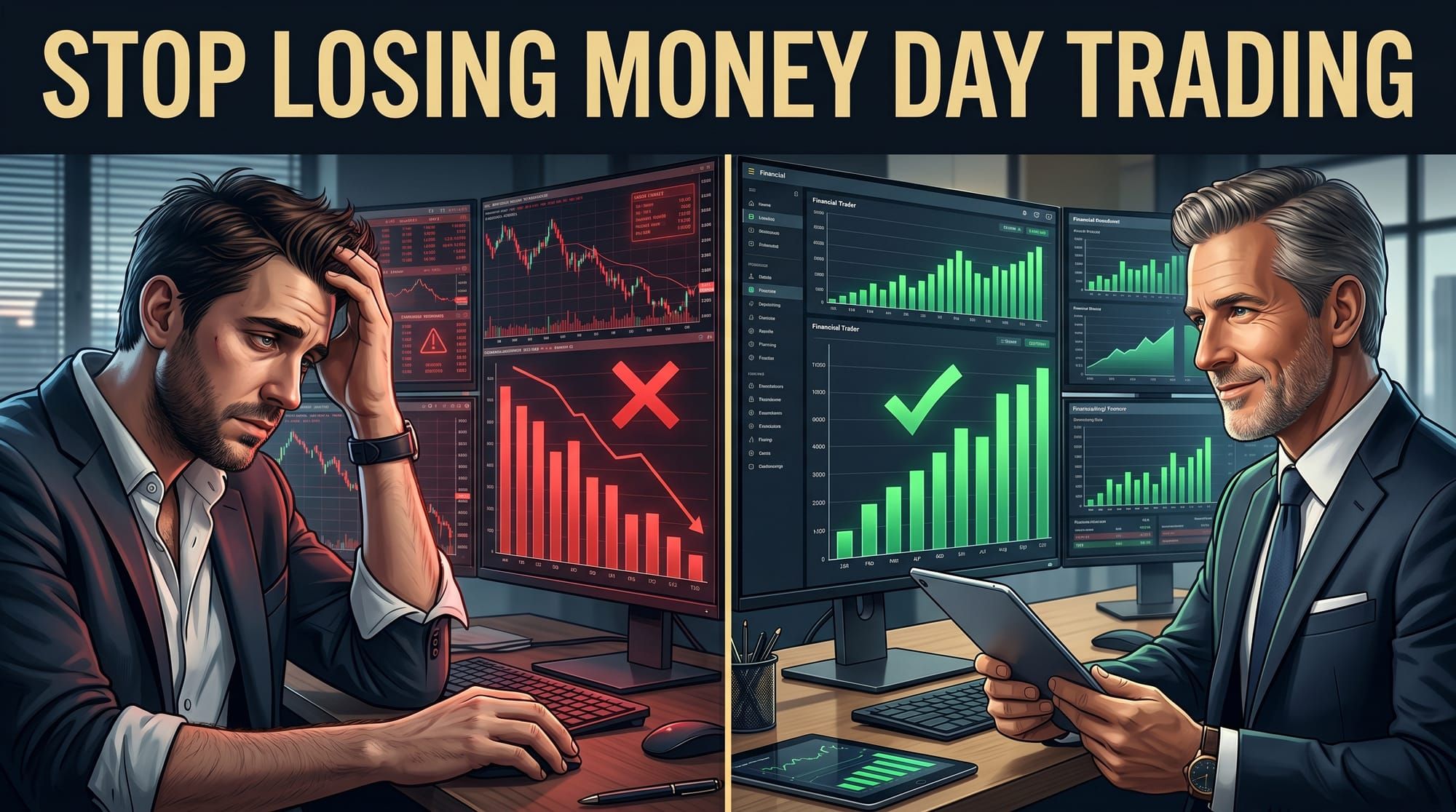
Most traders do not fail because they lack courage. They fail because they start with the hardest game in the market first.
Most traders are not losing because they are lazy, stupid, or incapable. They are losing because they chose the most unforgiving version of trading before they had the skill, structure, or emotional control to survive it. That is the mistake almost nobody talks about, and once you see it clearly, the rest of the puzzle starts to make sense.
Active traders are the ones in the arena. It takes real courage to put your capital, confidence, and judgment on the line and compete in the market. But courage alone is not a strategy. If your first move is to jump into the fastest, hardest, most tactical game in finance, you are making success less likely before the market even opens. The goal is not to prove how tough you are. The goal is to escape the 90% failure rate and build more predictable positive outcomes.
You are not losing because trading is impossible. You are losing because you started with the hardest version first.
The First Big Shift: You Do Not Need to Day Trade to Win
The first breakthrough for many struggling traders is simple but powerful: you do not need to day trade to make a living as an active trader. That single belief can save years of frustration, thousands of dollars, and an enormous amount of emotional wear and tear.
Too many people enter the markets assuming that the fastest style of trading must also be the most legitimate, exciting, or profitable. In reality, day trading is often the most technically demanding, the least forgiving, and the most psychologically brutal path available. That does not mean nobody can succeed at it. It means it should stop being treated like the default starting point.
The smarter question is not, “How do I trade harder?” The smarter question is, “What game am I actually playing, and is it the smartest game for me right now?”
There Is More Than One Way to Have an Edge
Investors broadly have two choices: passive or active. Passive investors get their edge from time, dollar-cost averaging, tax efficiency, low friction, positive market drift, and discipline. They let time do the heavy lifting and reduce the number of unnecessary decisions. Active investors get their edge from information, behavior, strategy, tactics, timing, mean reversion, and trends. Both approaches can work. The mistake is assuming there is only one respectable way to participate in the market.
Passive investing is powerful because it stacks long-term advantages that are often invisible in the short term. Buy-and-hold index funds, diversified asset allocation, and disciplined contributions can produce strong outcomes precisely because they remove friction, reduce emotional error, and harness time. Diversification across non-correlated assets is also a foundational risk-management principle in modern portfolio construction.
Active investing, on the other hand, gives you the chance to apply judgment, structure, and playbook-driven decision-making. But the best active traders do not rely on speed alone. They learn to use time as an ally rather than an enemy. They understand that extending the time frame can create more room for a thesis to work and more flexibility when a trade is not immediately perfect.
Time is not just a variable in trading. In many cases, time is the edge.
False Confidence Is Expensive
One of the biggest dangers in trading is false confidence. Many low-skill participants overestimate their competence, while truly skilled people tend to be more humble because they understand how much complexity is actually involved. In trading, that matters. False confidence leads to oversized positions, sloppy entries, rigid beliefs, and preventable losses.
There is a brutal but useful trading truth hidden in this idea: if you think you have trading figured out and you do not know what you need to learn next, you are probably the sucker at the table. The market punishes certainty far faster than it punishes humility.
Real skill usually looks quieter than beginners expect. It looks like discipline, risk control, self-awareness, and the ability to stay curious under pressure. The market does not reward ego. It rewards preparation, structure, and adaptability.
Trading Is Hard, but It Is Learnable
Trading is hard in the same way becoming an elite athlete is hard. The skill ceiling is high, the competition is relentless, and the feedback loop can be brutally expensive. But hard does not mean impossible. Trading is a craft, and like any craft, it can be learned by people who approach it with humility and structure.
The problem is that most people try to learn in the most punishing environment possible. They shorten the time frame, increase the emotional pressure, and force themselves into rapid decisions where every small mistake feels catastrophic. That is why one of the most practical lessons here is also one of the simplest: increase the time frame and give yourself more room to be wrong.
That shift alone can transform how you express a market opinion. Smart traders look for structures that create margin for error instead of forcing perfect timing. They stop demanding that every trade work instantly and start building positions that can survive normal uncertainty.
You will not win every trade. Nobody does. But if you understand your tools, you can often stay in the game. When trades get into trouble, skilled traders think in terms of management: extending time, reducing exposure, or shifting to a lower-risk position. The goal is not perfection. The goal is survival long enough for good process to compound.
Great traders do not survive because they are always right. They survive because they know how to avoid ruin.
Not All Active Traders Are Playing the Same Game
One of the most helpful ideas in this presentation is that active investors come in different forms. This matters because many traders judge themselves against people who are playing an entirely different game. That creates bad comparisons, bad expectations, and often bad strategy selection.
Day traders and scalpers play the most tactical game. They operate in extremely short windows, often in volatile and lower-liquidity names, and they need to recognize patterns almost instantly. This is close-quarters combat. It is fast, technical, and unforgiving.
Swing traders hold for days to weeks. They still depend on technicals, news, and information, but they have more time for setups to develop and more room for a thesis to work. This is a more operational style, closer to taking a well-placed shot than entering a knife fight.
Position traders think in weeks, months, and sometimes years. Their edge is less about split-second reactions and more about understanding fundamentals, earnings, operations, and economic cycles. This is a strategic game built on broader forces rather than minute-by-minute noise.
Discretionary traders are harder to categorize because they rely heavily on judgment, flexibility, and experience. But the same principle still applies: the more clearly you understand your game, the less likely you are to lose money trying to play somebody else’s.
The Real Path Forward Is Usually Less Exciting
The path to becoming a better trader is rarely glamorous. It is usually not about more adrenaline, more indicators, more screens, or more trades. It is usually about doing fewer things better, with more clarity and less ego.
Slow down. Trade smaller. Take advantage of structural edge. Buy the cheap hedge. Avoid ruin. That is not flashy advice, but it is grown-up advice. It is the kind of thinking that keeps you in the game long enough to become consistently dangerous.
The market will still be there tomorrow. Your job is to make sure your capital, confidence, and decision-making quality are still there too. Survival is not separate from success in trading. Survival is what makes success possible.
The Bottom Line
If you want to stop losing money day trading, stop asking how to push harder inside the hardest game in the market. Start asking whether you are choosing the right game, the right time frame, and the right structure for your current level of skill. That is where smarter trading begins.
You do not need to prove yourself by choosing the fastest path first. You need to build skill, protect capital, and use time, structure, and discipline to your advantage. The traders who last are not always the fastest. They are the ones who stack the odds, avoid ruin, and stay in the fight long enough to win.
Winning in the market is not about looking the smartest. It is about surviving long enough to become the most disciplined.
Ready to Trade Smarter?
If this message hit home, use it as your reset point. Stop glorifying the hardest version of trading. Start building a game you can actually win. Slow down. Extend your time frame. Protect your downside. Learn the craft.
Call to action: If you want more content like this, subscribe for future breakdowns on active trading, risk management, trade structure, and the mindset shifts that help traders stay in the game longer.
Educational content only. This is not financial advice.